
Most TikTok ads get skipped before the three-second mark. That’s not because the product is bad. It’s because the first frame looks like an ad.
You can have a great product, a real budget, and a clean campaign setup and still lose the viewer instantly. This piece breaks down six real TikTok campaigns with numbers pulled straight from TikTok for Business case studies and verified press coverage, not blog estimates.
Here’s what you’ll walk away with:
- Six ad campaigns with sourced, linkable results, from a 2019 hashtag challenge to a 2025 brand relaunch
- The actual hook-body-close structure TikTok’s own creative research supports
- A format guide that reflects TikTok’s current ad lineup, not a 2019 leftover
- A realistic creative testing process, without invented “kill” thresholds
- Current TikTok ad budget minimums and cost guidance for 2026
Table of Contents
Get Up to $6000 Free TikTok Ad Credit
Key Takeaways
- TikTok’s own data shows 90% of ad recall happens in the first six seconds, so your hook carries almost the entire job.
- The strongest case studies in this piece (Guess, Isle of Paradise, Too Faced, and Duolingo) come directly from TikTok for Business, with results TikTok itself published.
- Not every viral TikTok moment is a paid ad. Chipotle’s #GuacDance and Gap’s “Better in Denim” ran mostly as organic and hashtag campaigns, which changes what you should copy from them.
- TikTok recommends refreshing ad creative roughly every seven days once performance starts to slide, not on a fixed two-week schedule.
- TikTok ad budgets require at least $50 a day at the campaign level and $20 a day per ad group, according to TikTok’s own budget policy.
Quick Answer
A TikTok ad performs well when it opens with a fast, native-feeling hook, tells a short story instead of pitching, and ends with a CTA that fits the mood. TikTok’s own data ties 90% of ad recall to the first six seconds. Past that, results depend on your format, objective, offer, and how often you test new creative.
What Actually Makes a TikTok Ad Perform Well
Forget the idea that TikTok has a secret “virality formula.” It doesn’t publish one, and no outside source has proven one either.
What TikTok does publish is creative research built from real ad campaigns. Its Creative Best Practices guide lays out a three-part structure: hook, body, close. Each part has a specific job.
Here’s what TikTok’s own data backs up:
| Creative element | What TikTok’s data shows |
|---|---|
| Hook (first 3-6 seconds) | 90% of ad recall impact happens within the first six seconds |
| Product visibility | Showing the product on screen drives a 65% increase in brand affinity and a 25% lift in recall |
| Native, authentic style | Real-looking content earns roughly 3.3x more engagement than polished, repurposed ads |
| Trend participation | 77% of TikTok users say they like it when brands join trends, memes, or challenges |
Notice what’s missing from that table: a ranked list of “signals” like shares beating saves beating likes. That kind of claim shows up a lot in TikTok marketing blogs, but TikTok’s own creative documentation doesn’t rank engagement types that way. If you see it elsewhere, treat it as an opinion, not a platform fact.
The Hook-Body-Close Structure, Straight From TikTok
TikTok’s creative best practices recommend building every ad around three parts. Here’s what each one needs to do.
Hook. Get your value proposition on screen within the first three seconds. Use suspense, surprise, or emotion to hold attention past that point, since 90% of ad recall is decided in the first six seconds.
Body. Weave your brand and product in naturally instead of saving it for the end. Text overlays that give viewers a reason to keep reading also increase view time.
Close. Give the viewer a clear next step. TikTok recommends a genuine call to action, not a vague or absent one.
One correction worth making here: don’t treat “never show your logo early” as a rule. TikTok’s own case studies, including Too Faced later in this article, show consistent product and brand visibility performing well. The real principle is balance. Your brand should be identifiable early without opening on a static logo card.
How to Write a TikTok Hook That Stops the Scroll
Your hook decides whether the rest of your ad gets watched. Here are four hook types that consistently show up in high-performing TikTok creative, along with a simple formula for each.
Curiosity gap. State a specific result without explaining why yet. Example: “This $12 product replaced my whole skincare routine. Here’s why.”
Pain-first. Name a frustration your audience already feels before you offer a fix. Example: “If your ads keep getting skipped, you’re probably doing this.”
Pattern interrupt. Say something that pushes against common advice, then back it up fast. Example: “Stop polishing your videos. That’s why they’re getting skipped.”
Social proof. Lead with a real, specific number before you explain how you got it. Example: “This campaign hit 45 million views during our slowest season.”
If you’re stuck on wording, TikAdSuite’s TikTok ad hook generator can help you get a first draft going, and our guide on writing TikTok ad hooks covers more formulas in depth.
6 TikTok Ad Campaigns With Verified Results
Every result below comes from a TikTok for Business case study, a company newsroom, or verified press coverage. Three of these campaigns ran years ago and are labeled that way. One ran in 2025. What you should copy from each is different, so read the “what to steal” line before you borrow anything.
| Campaign | Year | Format | What it actually was |
|---|---|---|---|
| Chipotle #GuacDance | 2019 | Branded Hashtag Challenge | Organic/UGC challenge, not a paid ad |
| Guess #InMyDenim | 2018 | Brand Takeover + Hashtag Challenge | Paid takeover plus organic challenge |
| Isle of Paradise | 2020-2021 | Spark Ads | Paid amplification of creator content |
| Too Faced | Undated (TikTok case study) | Brand Takeover | Direct-response paid takeover |
| Duolingo | 2021 | One Day Max + In-Feed Ads | Paid media plan, not Spark Ads |
| Gap “Better in Denim” | 2025 | In-Feed + organic + creator | Mixed paid and organic brand relaunch |
1. Chipotle Turned a Hashtag Challenge Into 430 Million Video Starts
Chipotle built its #GuacDance challenge around National Avocado Day, using a song by children’s musician Dr. Jean. According to Chipotle’s own newsroom announcement, the challenge drove over 250,000 video submissions and nearly 430 million video starts in six days. TikTok called it the highest-performing branded challenge to run in the US at that point. Chipotle also served 802,000 sides of guacamole that day, its biggest guac day on record.
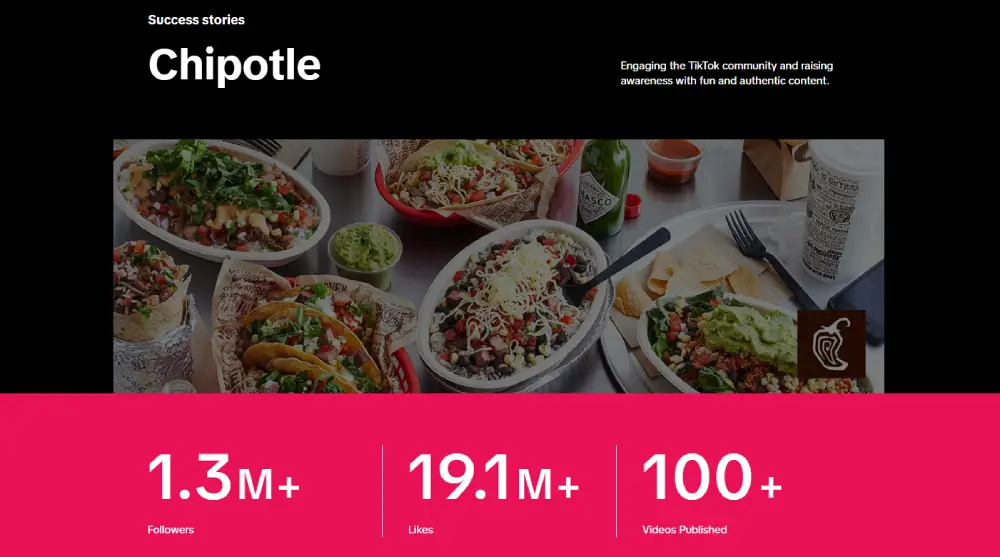
This was largely an organic and creator-seeded campaign, not a paid ad in the traditional sense. That distinction matters because the lessons are different from a Brand Takeover or In-Feed ad.
What to steal: tie a challenge to a real calendar date, offer one tangible reward, and give people exactly one simple action to copy.
2. Guess Used a Brand Takeover to Kickstart a Six-Day Hashtag Challenge
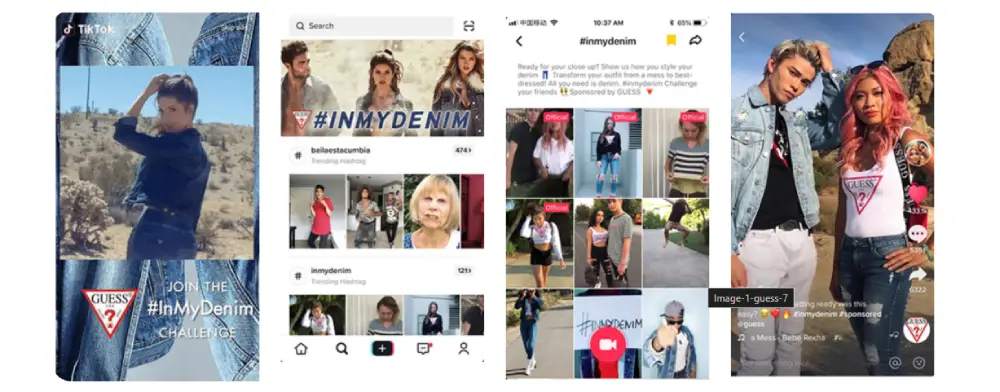
Guess launched a Brand Takeover on day one to promote its #InMyDenim challenge, paired with influencer seed videos using Bebe Rexha’s “I’m a Mess.” According to the TikTok for Business case study on Guess, the six-day campaign generated over 5,550 user-generated videos, 10.5 million video views, a 14.3% engagement rate, and more than 12,000 new followers for the brand’s account.
What to steal: if you’re launching in a short window, a Brand Takeover on day one can seed fast initial engagement that a hashtag challenge then carries forward.
3. Isle of Paradise Turned Creator Reviews Into a 500% ROI Spark Ads Campaign
Isle of Paradise didn’t shoot new content for this campaign. It found creators already posting organic testimonials about its Glow Drops product, licensed that content, and ran it as Spark Ads through TikTok Ads Manager. According to the TikTok for Business case study, the campaign produced a 500% return on investment, 45 million video views, a 1.1% click-through rate, and a 68% increase in weekly revenue compared to the nine weeks before launch. That result came during the brand’s off-season.
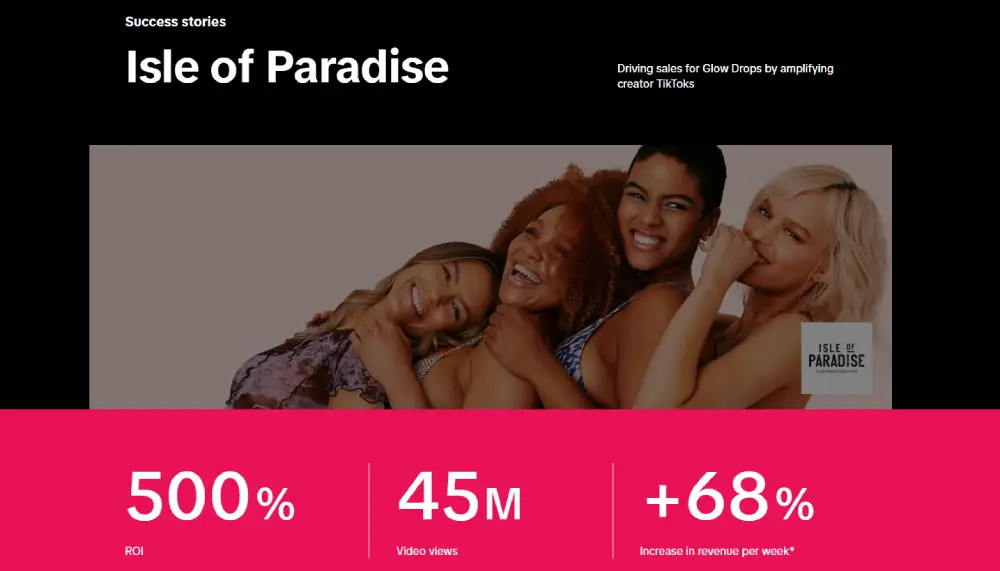
Because the content already carried real likes and comments, it read as an organic post rather than an ad. That’s a real advantage of Spark Ads. It’s not proof that creator testimonials always beat scripted creative everywhere, just that they worked well here.
What to steal: before shooting anything new, look for creators already talking about your product and consider licensing what’s already working.
4. Too Faced Proved a Brand Takeover Can Show the Logo and Still Convert
Too Faced used a five-second, full-screen Brand Takeover to promote its Lip Injection Extreme lip gloss to Gen Z shoppers in the UK. Per the TikTok for Business case study, the ad earned 7.6 million impressions and 2.54 million unique views in a single day, drove 1.3 million clicks to the product page, and hit an 18.38% click-through rate, well above the UK beauty benchmark at the time.
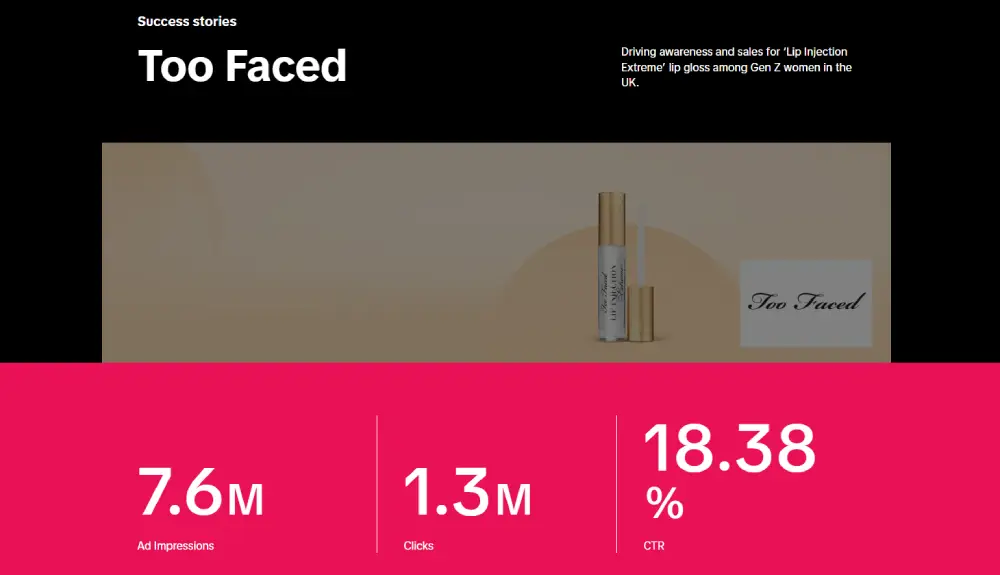
This case study is worth noting because it contradicts a common piece of advice. The creative used consistent product placement and clear branding throughout, not a hidden logo. Visible branding and a strong CTA worked together here.
What to steal: if your product delivers a fast, visible result, a Brand Takeover built around a clear before-and-after can work without hiding your brand.
5. Duolingo Used TikTok Lore and Spark Ads to Drive 12.63% Engagement
Duolingo’s TikTok Ad Awards-winning “Cult Mass” campaign shows how a brand can turn a viral moment into an ongoing story that feels native to TikTok. The campaign, which won the 2025 TikTok Ad Awards “Greatest TikTok” award, built on the viral story of Duo the Owl’s “death” and reimagined him as a cult leader. The campaign ran in Germany and used TikTok-first creative, including immersive POV content, cinematic scenes, and native TikTok assets.
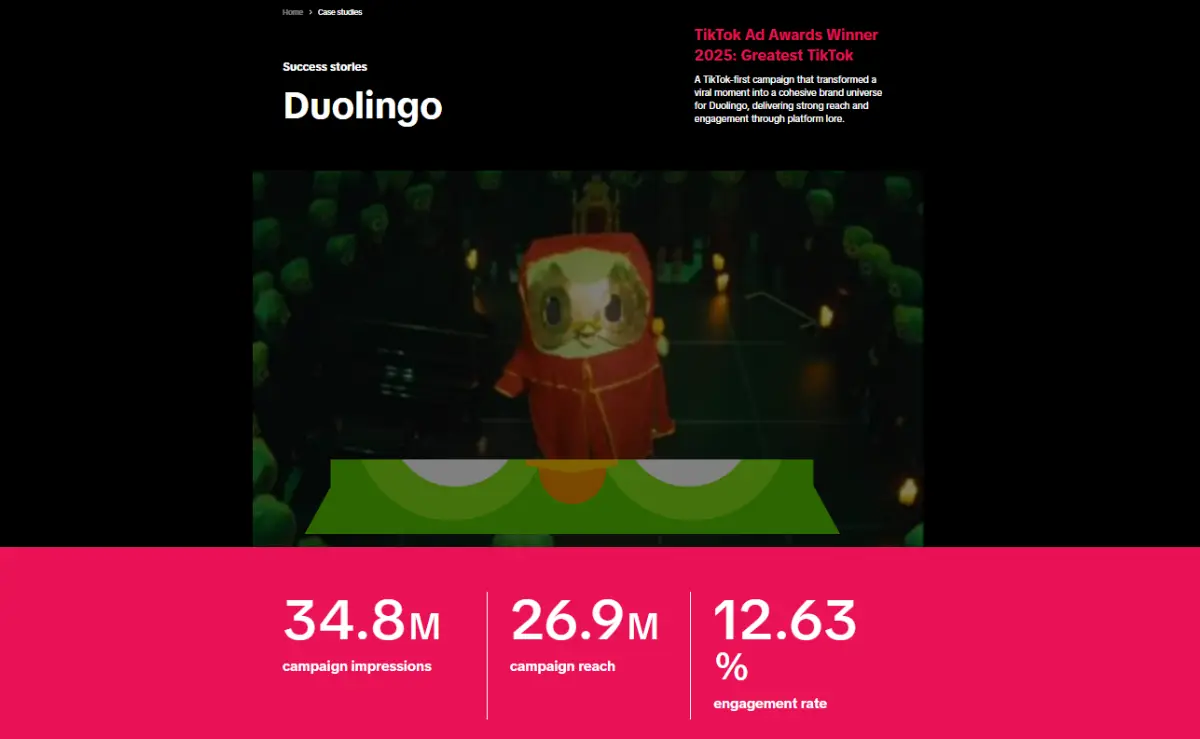
Duolingo also used Spark Ads to amplify the content that was already resonating with the TikTok community. The campaign connected Duolingo’s app mechanics with its fictional world, turning streak punishment into a ritual and positioning Duo as the cult’s high priest.
The campaign generated 34.83 million impressions, reached 26.89 million users, and produced 4.55 million interactions. Its engagement rate reached 12.63%, with 3.84 million reactions.
What to steal: Build a recognizable brand world around your TikTok content, then use Spark Ads to amplify the creative that already connects with the community instead of relying on conventional advertising alone.
6. Gap Turned a Creator Dance Video Into 8 Billion Impressions
Gap’s fall 2025 campaign paired the girl group KATSEYE with a dance routine set to Kelis’s “Milkshake” to relaunch its low-rise denim line. According to Marketing Dive’s coverage of Gap’s Q3 2025 earnings, the campaign generated 8 billion media impressions and more than 500 million views across platforms, and contributed to a 7% year-over-year rise in comparable sales alongside double-digit growth in Gap’s denim category.
This campaign mixed paid In-Feed placement, organic posting, and creator partnership rather than running as one isolated ad format, which is worth knowing before you try to copy it as a single tactic.
What to steal: pairing a song your audience already has emotional history with, alongside a simple, repeatable dance, gives people a reason to make their own version instead of just watching yours.
Which TikTok Ad Format Fits Your Goal
TikTok’s ad lineup has grown well past Brand Takeovers and Hashtag Challenges. Here’s a current starting point by goal, based on TikTok’s own creative advertising guide and current format documentation.
| Your goal | Format to start with | Why |
|---|---|---|
| Mass awareness on app open | TopView / Brand Takeover | Full screen, zero competing content |
| Community and UGC | Branded Hashtag Challenge | Turns viewers into participants |
| Amplify existing content | Spark Ads | Keeps social proof intact, feels native |
| Website traffic or conversions | In-Feed Ads | Full targeting control, scrollable |
| High-intent discovery | Search Ads | Reaches people already searching your category |
| Direct in-app sales | Video Shopping Ads / GMV Max | Shoppable product tiles, automated bidding |
Treat this as a starting point, not a rulebook. The format earns you the placement. Your creative still has to earn the result.
How Long Should a TikTok Ad Be?
There’s no single correct length, but there is a useful starting range. According to Sprout Social’s 2026 TikTok ads guide, in-feed video ads can run 5 to 60 seconds, with 9 to 15 seconds working as a common sweet spot for retention. That’s guidance, not a hard rule.
A few points worth keeping in mind:
- Brand Takeover creative has historically run around three to five seconds for video, based on TikTok’s own case studies.
- Spark Ads should generally keep the original creator’s video length, since trimming it can undercut the organic performance you’re trying to borrow.
- If your product needs more time to demonstrate, a longer, well-retained video can outperform a shorter one with weak completion. Length alone doesn’t decide the outcome.
Creative Strategies Worth Testing
A few creative habits show up consistently across TikTok’s own best-practice research and the case studies above.
Lead with a native, unpolished feel. TikTok’s own data shows authentic-feeling content earns close to 3.3x more engagement than repurposed, overly polished ads. That doesn’t mean high production always loses. It means content that feels TikTok-first tends to outperform content that feels lifted from another platform. Our guide on making TikTok ads that don’t look like ads covers this in more depth.
Use sound deliberately. Recognizable or trending audio can shape how people feel about your ad before they process a single word. If you need direction on picking a track, see our guide to choosing music for TikTok ads.
License what’s already working. As Isle of Paradise showed, creators who already made organic content about your product can become your fastest, most credible ad creative. Our UGC ads guide walks through how to source and license that content.
Cut your video natively. Tools like CapCut are built for TikTok-style edits, including fast cuts, text overlays, and trending transitions, without needing a full production setup.
Get the CTA right. A CTA that feels like a natural next step, not an interruption, tends to close better than a hard sell. Our guide to TikTok ad CTAs breaks down phrasing that works across formats.
How to Test and Refresh TikTok Ad Creative
Skip the idea of fixed thresholds like “kill at 40% completion” or “scale at 3% engagement.” Those numbers show up often in marketing blogs, but they’re not TikTok rules, and they fall apart the moment you compare a 7-second ad to a 45-second one.
Instead, build your testing process around your actual objective:
- Reach campaigns: watch reach, frequency, and ad recall.
- Traffic campaigns: watch click-through rate and landing page views.
- Conversion campaigns: watch cost per action and return on ad spend.
- App campaigns: watch cost per install and retention.
For creative refresh timing, TikTok’s own guidance, echoed in Sprout Social, recommends starting with a diverse set of creatives and refreshing roughly every seven days once you see performance decline, rather than sticking to a fixed weekly or biweekly calendar regardless of results.
TikTok’s Smart+ and Symphony tools can help automate some of that rotation if you’re managing volume. Our creative testing framework and TikAdSuite’s ad A/B testing tool can help you structure this without guessing.
5 Mistakes That Hold TikTok Ads Back
Treating every ad like a viral hashtag challenge. Most TikTok ad campaigns are paid In-Feed or Spark Ads, not organic UGC moments. Confusing the two leads to the wrong measurement plan.
Opening on a static logo or product shot. This kills momentum in the first second and gives the algorithm less reason to keep showing your ad.
Copying “rules” that aren’t TikTok’s. Claims like “shares always beat likes” or “soft CTAs always outperform hard ones” circulate constantly in TikTok marketing content without a traceable source. If you can’t find it in TikTok’s own documentation, treat it as an opinion.
Running one creative for weeks without checking performance. Creative fatigue is real, but the fix is watching your metrics, not following an arbitrary calendar.
Ignoring Search Ads. Plenty of brands only think in terms of feed interruption. TikTok users increasingly search the platform directly, and Search Ads catch that intent.
What TikTok Ads Cost in 2026
According to TikTok’s own budget policy, confirmed in Sprout Social, ad accounts must meet these minimums:
| Level | Minimum daily budget |
|---|---|
| Campaign | $50 |
| Ad group | $20 |
Beyond those floors, actual cost per click and cost per impression shift with your industry, audience, and auction competition. If you want a clearer sense of where your numbers should land, our TikTok ad benchmarks guide breaks down current ranges by objective.
Frequently Asked Questions
What makes a TikTok ad perform well?
A strong hook in the first six seconds, a native rather than polished feel, and a CTA that fits the tone of the ad. TikTok’s own data ties most ad recall to that opening window, so the hook does most of the heavy lifting.
Are TikTok’s viral hashtag challenges the same as paid TikTok ads?
No. Campaigns like Chipotle’s #GuacDance ran largely as organic, creator-seeded challenges. Paid ad formats like In-Feed, Spark Ads, and Brand Takeover work differently and need different creative and measurement approaches.
How long should a TikTok ad be?
Most in-feed ads run 9 to 15 seconds, though TikTok allows 5 to 60 seconds. Match the length to how long your product actually takes to explain, rather than cutting for the sake of a number.
How often should I refresh TikTok ad creative?
Start with several creative variations and refresh roughly every seven days once you see performance decline. There’s no fixed universal schedule that fits every account.
What’s the minimum budget to run TikTok ads?
TikTok requires at least $50 a day at the campaign level and $20 a day per ad group, according to TikTok’s official budget policy.
Putting This Into Practice
Start with the hook. Everything else in this guide only matters if someone is still watching after three seconds.
Pick one format from the table above that matches your actual goal, not the one that looks most exciting. Then build a short list of creative variations and test them against the metric that matches your objective, not a borrowed threshold from someone else’s campaign.
The six case studies here span 2018 to 2025 for a reason. TikTok’s format lineup keeps changing, but the core discipline doesn’t: verify your numbers, match your creative to your format, and keep testing.