
Most SaaS teams that try TikTok ads quit after six weeks. They ran a repurposed demo video, saw flat numbers, and decided the platform “doesn’t work for B2B.”
They failed because they didn’t understand the setup, then blamed the platform for the results.
TikTok is genuinely a useful channel for software companies, but only if you build the campaign the way TikTok actually works, not the way Google or Meta works.
This guide walks through what to budget, which ad formats fit SaaS, how to target the right buyers, and which numbers actually tell you if the campaign is working.
Here’s what you’ll learn:
- What TikTok actually requires as a minimum budget, and why the “$100 to $150 a day” rule you’ve seen elsewhere isn’t a platform requirement
- Which ad formats fit trial signups, lead generation, and retargeting
- How TikTok’s learning phase and lookalike audiences actually work, straight from TikTok’s own documentation
- A funnel structure that works differently for product-led SaaS versus sales-led SaaS
- The metrics worth tracking, and the ones that just measure visibility
Get Up to $6000 Free TikTok Ad Credit
Table of Contents
Key Takeaways
- TikTok can be cost-efficient for SaaS, but only when the creative looks native to the feed and the campaign includes retargeting, not just cold awareness.
- As of October 2025, TikTok’s single largest demographic is men aged 25 to 34, according to Sprout Social’s social media statistics report.
- TikTok’s actual minimum budgets are $50 a day at the campaign level and $20 a day per ad group. There’s no universal “$100 to $150” requirement.
- TikTok treats 50 conversions as a strong signal that an ad group has cleared the learning phase, not a hard pass-or-fail line.
- Lookalike audiences need a source list of at least 1,000 people, and TikTok offers Narrow, Balanced, or Broad sizing, not percentage tiers like some other platforms.
- Cost per trial start is useful, but trial-to-paid rate, CAC, and LTV matter just as much, especially for sales-led SaaS.
Do TikTok Ads Work for SaaS Companies?
Yes, but the outcome depends heavily on your product type and trial model. Self-serve SaaS with a free trial and a low price point tends to do well, since the buying decision happens fast and TikTok’s algorithm can optimize toward it. Sales-led SaaS with a long cycle needs a different setup: a lead-generation or demo-request campaign, not a trial-signup one.
Why More SaaS Companies Are Testing TikTok in 2026
TikTok’s audience has aged up. As of October 2025, the platform’s biggest single group is men aged 25 to 34, according to Sprout Social’s tracking of TikTok’s demographic data. That’s roughly the same age range making software purchasing decisions at growing companies. For a deeper breakdown by age, gender, and region, our TikTok user demographics guide covers the full picture.
TikTok also runs on an interest graph, not a follower graph. Your ad can reach a relevant audience on day one. You don’t need to build a following first for a paid campaign to work.
A handful of product-led software brands, including NotiTargetingon, Monday.com, and Canva, have built visible TikTok presences over the past two years. That doesn’t prove TikTok is their best-performing channel. It does show that software companies can use the platform at real scale without looking out of place.
What Actually Wastes Budget on TikTok SaaS Campaigns
Most wasted spend traces back to one of these four habits.
| Mistake | Why It Hurts |
|---|---|
| Repurposing website or LinkedIn creative | TikTok users scroll past anything that reads as a corporate ad within a couple of seconds |
| Running awareness campaigns with no follow-up plan | Video views alone don’t tell you if the campaign is producing trials or revenue |
| Skipping retargeting | Most trial decisions don’t happen on the first ad view |
| Optimizing for impressions or CPM | Visibility metrics don’t tell you what a trial actually costs you |
Awareness campaigns aren’t inherently a mistake. Brand-building, content distribution, and top-of-funnel education all have a place. The mistake is running an awareness objective when your actual business goal is trial signups, with no plan to retarget the people who watched.
How Much Should You Budget for TikTok Ads as a SaaS Company?
TikTok’s platform minimums are straightforward: a campaign-level daily budget must exceed $50, and an ad group-level daily budget must exceed $20. That’s the floor, not a recommended testing amount.
TikTok’s own budget guidance ties your starting spend to your optimization goal instead of handing out one flat number:
| Campaign Type | TikTok’s Recommended Minimum |
|---|---|
| Shallow conversion event (page view, sign-up start) | 50x your current cost per result |
| Install campaign | 20x your current cost per install |
| Deep conversion event (add to cart, purchase, subscribe) | 10x your current cost per result |
| No prior cost data | $100 (or local equivalent) as a starting point |
In practice, most SaaS teams testing TikTok for the first time land somewhere between $1,500 and $5,000 a month while they find a working creative and audience. That’s a working range based on what teams commonly spend to gather meaningful data, not a TikTok requirement.
Your own number should scale with your target cost per trial, not with a rule you read online. For a full breakdown of how to allocate spend across ad groups as you scale, see our TikTok ads budget optimization guide, or plan out your own numbers with our TikTok ad budget planner.
TikTok also runs seasonal ad credit promotions for new advertisers from time to time. It’s worth checking your eligibility for TikTok ad credit before you commit your first testing budget.
How TikTok’s Learning Phase Actually Works
This is one of the most misunderstood parts of TikTok advertising. TikTok’s documentation says performance volatility typically starts to decline after about 25 campaign results or 7 days once an ad group enters the learning phase.
Those are two different signals, and neither is an absolute requirement. Don’t set a budget purely to “hit 50 conversions.” Set it to generate enough conversion volume that TikTok’s system has real signal to work with, and give the campaign time before judging it.
A few things will reset or extend your learning phase:
- Pausing the campaign or ad group
- Editing targeting, budget, or creative mid-flight
- Setting a budget that’s too small for your conversion volume
Avoid all three during the first one to two weeks of a new campaign.
Best TikTok Ad Formats for SaaS
These sit at different levels of TikTok’s advertising structure. Some are placements, some are automation products, and some are objectives. Mixing them up is a common source of confusion.
| Format | What It Is | Best For |
|---|---|---|
| In-Feed Ads | A placement that appears natively in the scroll | Direct trial signups and cold-audience testing |
| Spark Ads | An ad built from an organic post, yours or an authorized creator’s | Trust-building using real engagement counts |
| Lead Generation Ads | An in-app form that skips your landing page | Email or demo-request capture with less friction |
| Smart+ Campaigns | TikTok’s AI-driven automation layer for targeting, bidding, and creative | Scaling a proven setup with less manual management |
In-Feed Ads are usually where SaaS teams should start. They support direct website conversion objectives and don’t require an existing TikTok presence. Spark Ads let you use organic posts from your own account or from creators who’ve authorized you, and the engagement counts attached to the post carry over, which is what makes them useful for building trust. For a closer comparison of when to use each, our guide on Spark Ads versus In-Feed Ads breaks down the setup differences.
Smart+ isn’t really an ad format. It’s TikTok’s automation layer that builds a single campaign powered by AI across targeting, optimization, and creative, and it works best once you already know what a winning creative and audience look like for your product. Running it cold, before you have any performance data, tends to waste the learning it needs to work well.
Lead Generation Ads have real value for sales-led SaaS that wants to capture a demo request without sending people off-platform. Some of TikTok’s newer lead-gen features are limited to Verified Business Accounts, so confirm your account type before building the campaign.
How to Build TikTok Creative That Actually Converts
Hooks That Stop the Scroll
Your first line needs to name a specific pain point or a specific outcome. Generic openers like “Introducing our new tool” don’t hold attention.
Three hook patterns that tend to work well for SaaS:
- Pain point: “If you’re still doing [task] by hand, you’re losing hours every week.”
- Outcome: “Here’s how a [job title] automated [specific workflow] in four clicks.”
- Curiosity: “Most [job title]s don’t know their [tool] can already do this.”
Each one speaks to a specific reader instead of a general audience. For more hook formulas by industry, see our TikTok ad hooks guide.
Screen Recordings and Talking Heads
Screen recordings, showing the actual product interface, are a natural fit for software because they demonstrate value directly instead of describing it. That doesn’t mean they’ll automatically outperform a talking-head video for your product. Treat it as a hypothesis worth testing, not a rule. Run both formats against the same offer and let your own data decide.
Writing a CTA That Doesn’t Sound Vague
Avoid “Learn more” or “Get started.” A viewer who’s watched 20 seconds of your ad wants to know exactly what happens next.
A useful CTA structure:
- State what they get: “Start your free trial”
- Name any real friction removed: only include “no credit card required” if that’s actually true for your trial
- Point to one clear action
Avoid Creative Fatigue
Finding one winning ad isn’t the finish line. TikTok creative burns out fast, sometimes within a week or two, as frequency climbs and watch time drops. Build a rotating set of concepts rather than leaning on a single winner, and refresh hooks before performance actually declines. Our creative testing framework covers how to structure that testing cadence.
Which TikTok Targeting Options Actually Fit B2B SaaS?
TikTok gives you three separate targeting systems, and they aren’t interchangeable.
Interest targeting finds people based on long-term interests and how they interact with content on TikTok, useful when you don’t yet have detailed audience data. Behavior targeting looks at recent actions, like watching or engaging with related videos. Search Ads run separately and let you bid on the actual terms people type into TikTok’s search bar, with keyword-level bidding available only within the Search Ads Campaign Traffic objective. Our TikTok Search Ads guide covers how that setup differs from standard targeting.
For B2B SaaS specifically, useful interest categories include business and entrepreneurship, software and technology, and marketing and advertising.
Custom and Lookalike Audiences
Custom audiences from your CRM, email list, or the TikTok Pixel are your strongest targeting asset, since they let you retarget people who already showed intent.
Once you have enough data, you can build a lookalike audience. TikTok’s system differs from what you may know from other platforms: it doesn’t use percentage tiers. Instead, you choose between Narrow, Balanced, and Broad audience sizes, and TikTok requires a source audience of at least 1,000 people before it will build one.
Narrow prioritizes similarity to your source list; Broad trades some similarity for reach. Our guide on custom audiences versus lookalike audiences walks through how to build a source list correctly, and our lookalike audience builder can help you size one out.
A lookalike built from paying customers can outperform one built from trial starters, since it’s modeled on the outcome you actually want. Test both rather than assuming one will win by default.
How TikTok Targeting Compares to LinkedIn
LinkedIn’s average cost per click runs $6 to $7 globally, and $8 to $10 in the US, according to WebFX’s advertising benchmarks. (source) TikTok’s costs generally run lower for similar reach. That said, LinkedIn’s job-title and seniority targeting isn’t something TikTok replicates directly.
TikTok approximates a B2B audience through interests, behaviors, and lookalikes, which is a real advantage on cost but a real difference in targeting precision. Weigh both before assuming one platform simply beats the other for your buyer.
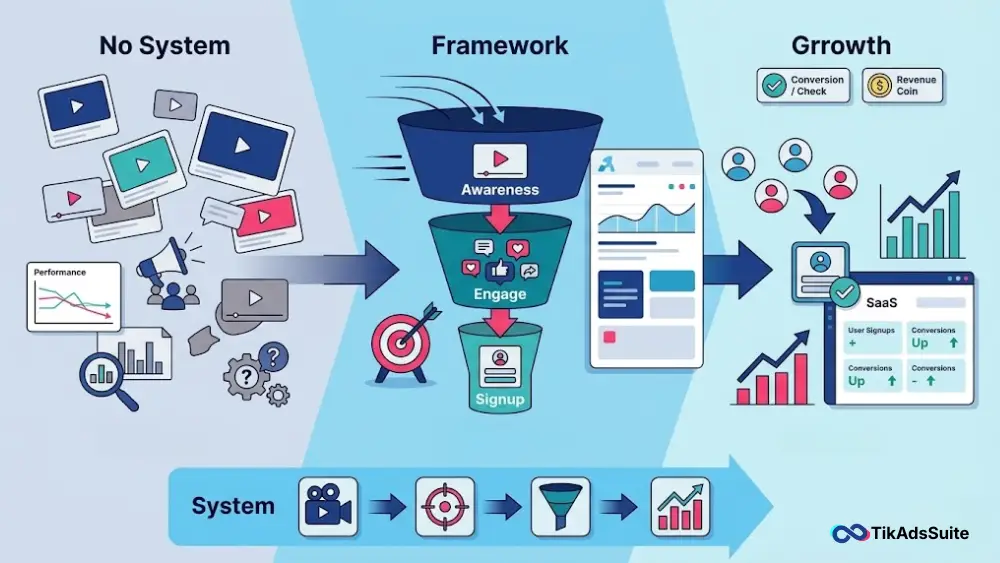
How to Structure a Full-Funnel TikTok Campaign for SaaS
Your funnel should look different depending on how your SaaS product sells.
Product-led SaaS with a self-serve trial:
- Cold audience → website conversion campaign optimized for trial start
- Retarget people who watched 50% or more of your video or visited your trial page
- Feed activation data back to TikTok where possible, not just the initial signup
Sales-led SaaS with a longer cycle:
- Cold audience → lead generation or demo-request campaign
- Retarget engaged viewers with content that builds trust, case studies and product walkthroughs work well here
- Track the full path from lead to opportunity to closed revenue in your CRM, not just the ad click
For a broader look at building this out stage by stage, our TikTok ads funnel guide goes deeper on retargeting audiences and timing.
On bidding, TikTok gives you two main options: Maximum Delivery, which spends your full budget for the most volume, and Cost Cap, which holds your cost per result to a target you set. A Cost Cap bid set too low can choke delivery entirely. If a campaign isn’t spending, raise the cap or switch to Maximum Delivery before assuming the audience is the problem.
How to Measure TikTok Ad Performance for SaaS
Impressions and CPM tell you about reach. They don’t tell you whether the campaign is working for your business.
| Metric | What It Tells You |
|---|---|
| Cost per trial start | Your core acquisition efficiency number |
| Trial-to-paid conversion rate | Whether TikTok is sending the right kind of user, not just a high volume of them |
| CAC by channel | How TikTok compares to your other acquisition sources |
| Average watch time | Creative performance, benchmark it against your own account history, not a fixed percentage |
| Cost per video view | Useful only for awareness-stage budgeting, not a proxy for reach or business results |
Cost per trial start and trial-to-paid rate are the two numbers most SaaS teams should watch first, but they aren’t the only ones that matter. CAC, LTV, and payback period still decide whether the channel is actually profitable, especially once a trial converts weeks after the ad click.
Install the TikTok Pixel and add UTM parameters to every ad link so signups show up correctly in your CRM. Adding “TikTok” as an option in your “how did you hear about us” field gives you a useful self-reported signal too, though people forget or misattribute channels often enough that it shouldn’t be your only source of truth. For a full list of what to track and why, see our TikTok ads metrics guide.
Once you’ve validated a working setup, setting up your account properly matters just as much as the campaign itself. Our TikTok Business walkthrough covers account setup if you’re starting from scratch.
Frequently Asked Questions
Is TikTok a good channel for B2B SaaS marketing?
It can be, particularly for products targeting marketers, founders, developers, and small business operators who are active on the platform. Results depend heavily on whether your creative looks native to the feed rather than repurposed from a website or LinkedIn post. Enterprise SaaS selling to procurement teams tends to see weaker direct-response results, though it can still work for brand awareness.
What’s a realistic minimum daily budget to start testing?
TikTok’s hard platform floor is $50 a day at the campaign level and $20 a day per ad group. Most SaaS teams testing for the first time budget higher than that, often $50 to $150 a day, to gather enough conversion data within a few weeks. There’s no single number TikTok requires.
How long before I know if TikTok ads are working for my SaaS product?
Give a new campaign at least two to four weeks before drawing conclusions. TikTok’s algorithm needs real conversion volume to optimize delivery, and judging performance in the first few days almost always leads to cutting a campaign that hadn’t stabilized yet.
Do I need an active TikTok account to run ads?
No, you don’t need an organic TikTok account to run In-Feed Ads or Lead Generation Ads. You do need a TikTok account to run Spark Ads, since that format is built from an existing organic post that you own or have creator authorization to use.
How do I track which TikTok ads actually drive paid conversions, not just trials?
Install the TikTok Pixel and set up a custom conversion event for trial signup, then track the downstream activation and paid-conversion events through your own analytics or CRM rather than TikTok alone. TikTok’s platform reporting shows you the ad-level numbers, but your CRM is what tells you whether those trials actually turned into revenue.
Where to Start
If you’re testing TikTok for SaaS for the first time, don’t start with a big budget or a fully automated Smart+ setup. Start with an In-Feed campaign, two or three creative concepts built around a real pain point, and a budget that fits your target cost per trial. Give it two to three weeks before you touch anything.
Once you have real conversion data, that’s when retargeting, lookalikes, and Smart+ actually start to pay off. Everything in this guide works better once you have a baseline to build on, not before.